
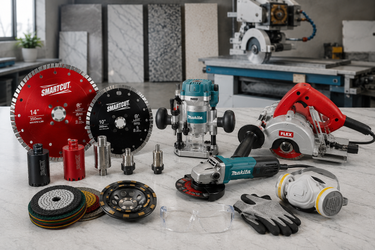
10 Essential Tools Every Granite & Quartz Fabrication Shop Needs
Whether you're setting up a new shop or auditing what's on your bench, having the right tool for each stage of the job — cutting, drilling, shaping, and polishing — is the difference between a clean install and a callback. Here's the core toolkit that professional stone fabricators rely on, and what each tool is actually for.

1. Diamond Blades
The foundation of any shop. A good diamond blade set covers granite, quartz, and marble separately, since each material needs a different bond hardness and rim type to cut cleanly without chipping. Most shops keep at least a turbo blade for speed and a continuous rim blade for polished edges.
2. Diamond Core Bits
Core bits drill the clean, round holes needed for sink cutouts, faucet holes, and outlet openings. Bit quality matters here more than almost anywhere else — a dull or mismatched core bit is one of the fastest ways to crack a slab you've already invested hours into.
3. CNC Router Bits
Shops running a CNC bridge saw or router need bits specifically designed for stone, not wood or metal. The right router bit profile (straight, bullnose, ogee, bevel) determines both cut quality and how much hand-finishing is needed afterward.
4. Polishing Pads
Once a piece is cut and shaped, polishing pads bring the edge or surface to its final finish. Fabricators typically run a full grit progression — from coarse to fine — to go from a rough-cut edge to a mirror polish.
5. Profile Wheels
For decorative edges (bullnose, ogee, bevel, dupont), profile wheels shape the edge before polishing pads take over. Having a range of profile wheels lets a shop offer more edge-style options without outsourcing the work.
6. Sink/Grinder Blades
Smaller diameter blades made for tight, detailed cuts — sink cutouts, corners, and areas a full-size blade can't reach cleanly. These pair with a hand grinder rather than a bridge saw.
7. Adhesives & Seam Fillers
Color-matched adhesives and seam fillers make seams disappear and repair small chips before a slab ever leaves the shop. Keeping a range of colors on hand avoids delays waiting on a special order mid-install.
8. Suction Cups & Slab Lifters
Moving heavy slabs safely protects both the material and your crew. Quality suction cups and lifting equipment reduce the risk of cracked slabs during transport and setting — an expensive mistake to make twice.
9. Water Management Tools
Wet cutting is standard for most stone work, so reliable water flow — hoses, pumps, and fittings sized correctly for your saw — keeps blades cool and dust down. Poor water flow is a common, overlooked cause of premature blade wear.
10. Safety Gear
Cut-resistant gloves, eye protection, and hearing protection aren't optional in a shop running blades and grinders all day. Beyond compliance, the right gear is what keeps a two-person shop from becoming a one-person shop after an accident.
Building Your Shop's Toolkit
Not every shop needs every tool on day one. A good approach:
- Starting out: blades, core bits, and basic safety gear cover the majority of standard countertop jobs
- Scaling up: add profile wheels and a fuller polishing pad progression to offer more finish options
- Running CNC: invest in a proper router bit set matched to your machine and the materials you cut most
Frequently Asked Questions
What's the most commonly underestimated tool in a stone shop? Water management. Fabricators focus on blades and bits, but inconsistent water flow is one of the most common reasons a blade wears out faster than it should.
Do I need different tools for quartz versus granite? Yes, in most cases. Quartz's resin content behaves differently under a blade or bit than natural granite, so tools built specifically for engineered stone typically hold up better and produce a cleaner edge.
How often should polishing pads be replaced? It depends on grit and usage volume, but a pad that's stopped producing a consistent finish — even after cleaning — is past its useful life and worth replacing rather than pushing through.
Smartcut Professional Tools has supplied blades, core bits, and fabrication tools to stone professionals since 2004. Browse our full tool catalog to build out your shop's toolkit.


