
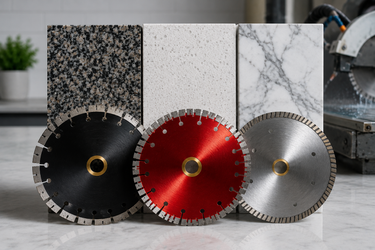
How to Choose the Right Diamond Blade for Cutting Granite, Quartz & Marble
If you've ever burned through a blade in half the time you expected — or watched a $3,000 slab chip along the cut line — you already know that "diamond blade" is not a one-size-fits-all product. The bond, the rim, the arbor, and even the water flow all change depending on what material you're cutting and what machine you're running.
This guide breaks down exactly how to choose the right blade for the job, so you spend less on replacements and get cleaner cuts on every slab.

Why the Wrong Blade Costs You More Than It Saves
A cheaper blade that dulls fast, glazes over, or chips your material isn't actually cheaper. Fabricators who switch blades every job — instead of matching the blade to the stone — typically deal with three problems:
- Slower cutting speed, which eats into billable shop hours
- Chipping and micro-fractures along the cut edge, especially on polished granite and quartz
- Premature wear, because the bond hardness doesn't match the material's abrasiveness
Getting the blade-to-material match right the first time solves all three.
Step 1: Match the Blade to the Material
Granite
Granite is hard and abrasive, so it wears down a diamond blade's bond quickly. A granite blade needs a softer metal bond that releases diamonds at a controlled rate, continuously exposing fresh, sharp diamond as the blade cuts — this keeps the blade cutting fast instead of glazing over.
Quartz & Engineered Stone
Engineered stone (quartz) contains resin along with silica, which behaves differently under the blade than natural stone. A blade built specifically as a quartz or Dekton blade uses a bond and segment design tuned for that resin-silica mix, reducing chipping on the finished edge — something a general-purpose blade often can't do cleanly.
Marble & Softer Stone
Marble is softer but more prone to chipping and cracking under pressure. Marble blades typically run a continuous rim rather than a segmented one, which produces a smoother, chip-free edge critical for polished marble work.
Step 2: Choose the Right Rim Type

- Turbo Blades — segmented, "turbo" style rim for fast, aggressive cutting; best when speed matters more than a glass-smooth edge.
- Continuous Rim Blades — smooth edge, slower cut, ideal for marble, tile, and anywhere chipping is unacceptable.
- Segmented Blades — open gullets between segments improve cooling and debris clearance, useful for thicker, harder material and dry-cutting applications.
Step 3: Check Bond Hardness Against Stone Hardness
This is the step most fabricators skip — and it's the one that determines how long a blade actually lasts.

- Harder stone → softer bond. A softer bond wears away faster, constantly exposing new diamond, which keeps the blade cutting efficiently through hard granite.
- Softer stone → harder bond. A harder bond wears more slowly, which is what you want on marble and other softer materials, so the blade doesn't burn through diamond before the material even needs it.
If your blade feels like it's "burning" the stone instead of cutting it, the bond is very likely too hard for the material you're cutting.
Step 4: Match Arbor Size and RPM to Your Machine
Before ordering, confirm:
- Arbor size — matches your bridge saw, wet saw, or angle grinder exactly (no adapters that could introduce vibration)
- Maximum RPM rating — never exceed the blade's rated RPM, even if your machine can spin faster
- Wet vs. dry rated — wet-rated blades need water flow to manage heat; running one dry will destroy it fast
Step 5: Wet or Dry Cutting?
Wet cutting is the standard for most granite, quartz, and marble fabrication — water controls dust, cools the blade, and extends its life significantly. Dry-cutting blades exist for job-site or portable work where water isn't practical, but they wear faster and require more frequent cooling pauses to avoid overheating the diamond segments.
Quick Reference: Blade Selection Checklist
Identify the material: granite, quartz/engineered stone, marble, or porcelain
Pick the rim type: turbo, segmented, or continuous
Match bond hardness to stone hardness
Confirm arbor size and RPM rating against your machine
Decide wet or dry based on your setup
Frequently Asked Questions
How long should a diamond blade last? It depends heavily on the material, bond hardness, and how well the blade is matched to the job — but a properly matched blade run at the correct RPM with adequate water flow will consistently outlast a mismatched one by a wide margin.
Can I use the same blade for granite and quartz? You can in a pinch, but you'll get better edge quality and blade life by using a blade designed for each material, since granite and quartz wear differently on the bond.
Why is my blade glazing over instead of cutting? This usually means the bond is too hard for the material — the diamonds aren't being exposed fast enough to keep cutting efficiently. Switching to a softer bond blade typically resolves it.
SMARTCUT Professional Tools has supplied blades, core bits, and fabrication tools to stone professionals since 2004. Browse our full lineup of granite blades, quartz blades, and turbo blades to find the right match for your next job.


